An underground storm shelter puts you below grade, out of the wind entirely
An underground storm shelter puts the occupants beneath the ground surface, where wind speed is not a factor and flying debris cannot reach except through the lid. That is the appeal, and it is real. West Texas has a long memory of storm cellars — the old ones are still out there behind farmhouses from Merkel to Anson — and for a lot of Big Country households below grade is simply where a tornado plan feels right.
The engineering reality is more balanced than the instinct. A modern above-ground safe room tested to the same standard offers protection described under FEMA P-361 as near-absolute, so the decision between them is not really about safety margin. It is about your lot, your ground, and who has to get down the steps.
The West Texas ground question, answered honestly
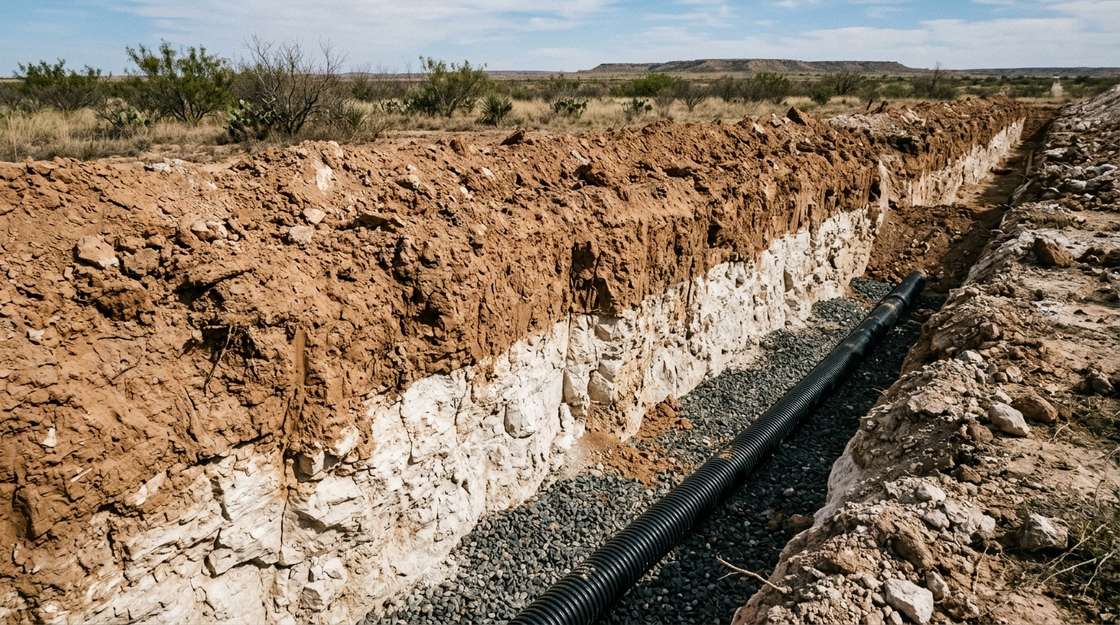
Around Abilene the dig is usually a two-layer problem: reddish-brown expansive clay over pale caliche hardpan, with the caliche arriving anywhere from inches to several feet down. Neither layer stops an underground shelter. The clay moves with moisture — it swells wet and shrinks dry, which is why West Texas foundations crack — and the caliche digs slow. Both are equipment-and-design questions a Big Country crew handles routinely:
- What is actually down there. The cut face tells the truth on install day, but an experienced local estimator reads the lot, the neighborhood and the nearby cuts first.
- How the backfill is handled. Expansive clay wants proper compaction and drainage so the shelter does not become the low point every storm drains toward.
- Drainage design. A gravel bed, a sealed lid and sensible siting above the lot's natural drainage paths. Dry country still rains — it just does it all at once.
- Flotation. Less of a concern here than in wet states, but a light steel box in saturated clay still gets anchored like it could float, because one soaked spring is enough.
Concrete or steel storm shelters
Both are in use across West Texas and both can be rated to ICC-500 and FEMA P-361.
- Precast concrete. Heavy, stable, and indifferent to soil moisture cycles. Needs access for a truck and a crane or boom to set it.
- Steel. Lighter and easier to place on a tight lot, and quick to install — but it must be properly coated and anchored, and the drainage detail matters more.
Where the storm shelter goes on the lot
Back-yard placement is straightforward on most Taylor and Jones county lots, but pay attention to the path from your back door to the lid. If the run is exposed and forty feet long, you will hesitate to use it at 5:40 a.m. in driving rain and hail — and a storm shelter you hesitate about is a storm shelter you do not reach in time. In-garage placement solves that at the cost of a slab cut and repour; the garage storm shelters page covers that install.
Utility locates come before any digging, without exception. Gas, water, sewer, electric and communications all get marked, and on rural properties there is often a private water line, an old septic run or buried irrigation that never appears on a locate ticket — tell the crew about anything you know.
If stairs are a problem for anyone in the household, read the above-ground safe rooms page before deciding — access beats everything else.