The Big Country has a real storm shelter rebate. Most people have never heard of it.
In most of the country, the answer to “is there a storm shelter rebate?” is a disappointing no. Abilene is the exception: the West Central Texas Council of Governments — headquartered at 3702 Loop 322, right here in Abilene — runs an Individual Residential Safe Room Program that rebates 50 percent of the cost of a qualifying safe room or storm shelter, up to $3,000. The money comes from a FEMA grant administered through the Texas Division of Emergency Management.
| Question | Answer |
|---|---|
| How much | 50% of cost, up to $3,000 |
| What qualifies | Safe rooms / storm shelters meeting FEMA criteria — above-ground and underground |
| Where | All 19 WCTCOG counties, incl. Taylor, Jones, Callahan and Nolan |
| The critical rule | Apply and receive the award BEFORE installation — the program is not retroactive |
| How you actually pay | Reimbursement — you pay 100% upfront, the rebate comes back on approved paperwork |
| Exclusion | Single-family homes and duplexes only, outside a FEMA or locally mapped 100-year floodplain |
| Also required | You agree to a WCTCOG site visit and photos, and to your shelter's GPS coordinates going into the local 911 database |
| Status | Active as of August 2026. First-come, first-served as funding is received — not guaranteed, and WCTCOG expects more applications than it can fund |
The order of operations, and the trap
Every detail of this program is friendly except one: the sequence. It runs application → written rebate award → installation → documentation → rebate, and it does not run in any other order. A homeowner who gets a great quote in April, installs in May and asks about the rebate in June has a tested shelter and no rebate — the guidelines state flatly that the program is not retroactive and that any shelter installed before the award is not eligible.
- Step 1 — check the floodplain. The program covers single-family homes and duplexes outside a FEMA or locally mapped 100-year floodplain. Quick to check, and WCTCOG can help.
- Step 2 — apply, and apply early. Submit the application with proof of ownership and the floodplain documentation, then wait for the written award. Rebates go first-come, first-served as WCTCOG receives funding, so the queue position is worth having.
- Step 3 — install a qualifying shelter. It must be built to FEMA P-320, FEMA P-361 and ICC-500 design standards; the installer supplies the compliance documentation.
- Step 4 — submit everything. The notarized Texas Division of Emergency Management certificate of installation and inspection, contractor invoices, permits, proof of payment in full, and the shelter's GPS coordinates. That is what releases the money.
Two things about this program nobody tells you
You pay the whole price first. The guidelines require the applicant to pay 100 percent for the safe room upfront and claim the rebate afterward with proof of payment. This is a reimbursement, not a discount at signing, so arrange financing around the full number.
It is not guaranteed. WCTCOG's own guidelines say rebates are awarded only as funding is received, that rebates are not guaranteed, and that there is a high probability the program will receive more applications than it can fund. That is not a reason to skip applying — it is free to try and the upside is $3,000 — but it is a reason to treat the rebate as a possible refund rather than money already in your budget.
One more requirement worth knowing, because it is genuinely useful rather than bureaucratic: participants agree to have the shelter's latitude and longitude passed to their local emergency management coordinator for the 911 database, so fire and police can find the shelter after a storm. That is the same idea as the City of Abilene's shelter registry, and it is one of the better arguments for going through the program even if the rebate itself never comes through.
WCTCOG is local and reachable: 3702 Loop 322, Abilene, 325-672-8544. One call confirms current funding, the floodplain question and the application packet.
Why this program matters more here than a discount would
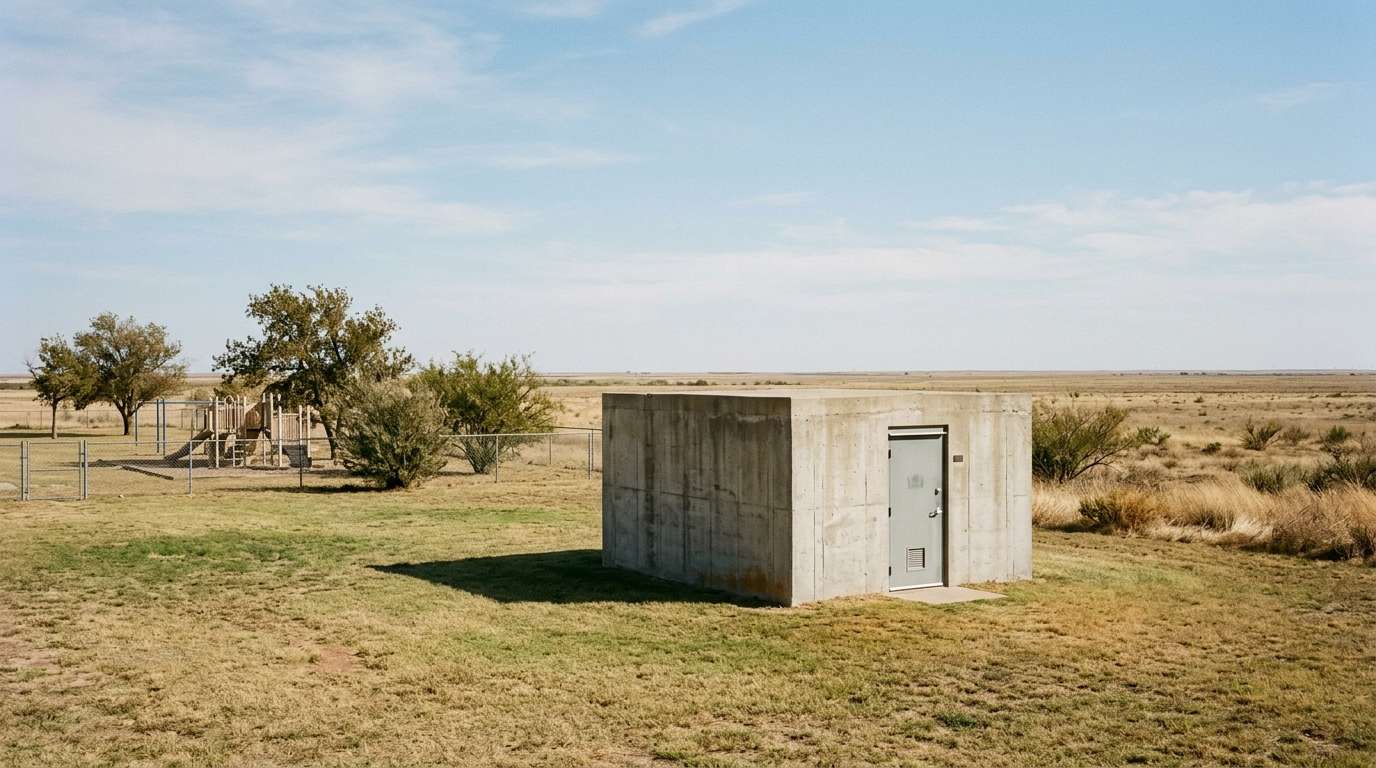
Abilene has no public storm shelters. The city says so plainly, and its guidance for households without a shelter is an interior windowless room — because that is all there is to say. When the 2019 tornado came through at 5:40 in the morning, there was no municipal shelter to drive to, and driving during a warning is not a plan anyway. The region's answer is this program: instead of building public shelters, the grant helps households put a tested shelter inside their own four walls, where it can actually be reached in the ninety seconds that matter.
What else genuinely helps you pay for a storm shelter
- The rebate first. It is the single biggest lever — half the cost up to $3,000 — and it costs one application. Everything else is second to getting the sequence right.
- Dealer financing. Most established shelter dealers offer it for the remainder. Compare the total cost of credit, not just the monthly figure.
- Ask your insurer. Whether a rated shelter earns any credit varies by carrier, and no honest page can promise you a number. It is one phone call and the answer is occasionally worth having.
- Buy off-season. Demand and lead times spike after every regional tornado and through the spring peak. Late summer through winter is the quiet window — and it gives the WCTCOG approval time to arrive before the season does.
- Right-size honestly. Capacity tiers are the biggest single lever on the base price. Size for the household, not for the largest gathering you have ever hosted.
When you are ready to price a shelter with the rebate math included, the cost page has the bands and the contact page starts the quote.